Wednesday, October 24, 2012

NORMAL MEDICINE


Our society today has shaped us in belief of the definition of normality. Professor discussed in lecture that “normal” is defined by measurements of a group of “healthy” beings and that anyone outside of that boundary is the outcast. With so many different variations of cultures around the world there is no possible way of creating an image of a normal person, so why is the social and medical construction of normal deeply engraved in health? As I started to read, Culture Behavior and Health by Scrimshaw, I started to connect how the idea of classifying someone as a normal person creates a bias for what we believe as what is normal medicine. And because cultures are different there aren’t standard medicine procedures that would essentially work for all, especially with aspects of culture constantly changing. Scrimshaw states, “Culture has developed its own ways of solving the problems of how to live together.” Limiting global health to the perception of a “normal” person undermines the influence culture has on health and further marginalizes others.

In lecture we learned about how our perceptions of normality that we subconsciously developed from our culture aren’t indeed accurate because normal does not exist. For example, Professor had asked what the difference between, “Westerners” not believing in sorcery and someone from a different region not believing in genes. It’s “normal” for us to believe in genes because it is normalized in our culture’s health system and for others to believe in sorcery because it is normalized in their cultural beliefs. With two different culture views that impact/influence the way they practice medicine, it is impossible to classify one as normal. However, in our modernized society we have ranked Western Biomedicine as the “normal” method. Enforcing this belief proposes a major challenge to Global Health. Not understanding the difference between one cultures way of healing versus another enables us from not only communication but working together to help prevent diseases/illnesses.

Our society produces our ethnocentric view of health. Growing up in the U.S, I was always taught that Western Biomedicine is the best form of medicine. Other cultures different forms of medicines are rarely discussed. In the video during lecture, we watched the journey of an anthropologist traveling to India to understand their methods of healing. Initially when he explained to U.S doctors that his shoulder isn’t flexible they suggested using surgery to insert a metal joint.  The doctor notified him that this procedure causes severe health side effects. When he explained to the doctors in India about his arm stiffness they gave him body rubs with various substances. After a while, he noticed that his shoulder was starting to loosen up. Cultures have different approaches of healing and also different definitions of diagnosing an illness.

The idea of using one cultures method of medicine onto other’s connecting me to the article from the Huffington Post, Traditional Chinese Medicine Focuses More On Healing Body Than Curing Disease: Analysis. The article explains how in Chinese culture the mind and body are categorized as one. They focus on healing the person rather than healing the disease. In Western Biomedicine doctors focus on the biological disease rather than healing the mind body and soul of a person. Similar to the Indian culture they use massages/ bodily rubs and also acupuncture. In their culture this method of healing is proven to be very powerful. This proves that although our culture does not focus on healing the mind of the person doesn’t make the Chinese method of healing not normal.  Pushing for an image of a “normal” person with the constant evolving of cultures around the world, in my opinion dehumanizes left winged practices.

In the article, Culture Behavior and Health by Scrimshaw she mentions the dangers of using your medical beliefs to criticize other cultures treatment processes. In one instance where epidemiologist encouraged Bolivian peasants to stop putting clay in their drinks because they believed it was “wrong” ended up making the Bolivians sick. Instead of understanding that the Bolivians were drinking the fine clay because of its rich source of calcium and for digestion, they used their dominate Western Biomedical perspective. What prompted epidemiologist to instruct the Bolivians to stop? The social and medical construction of normal in their culture out ruled their decision. What is normalized in one culture does not mean it is meant to be normalized in another. Therefore, creating an image of a “normal” person/ medicine prompts serious health risks. As Scrimshaw also states, “to understand the cultural context of health..the concepts of insider outsider perspectives are useful”. She describes the situation of Guatemalan mothers who believed worms in children weren’t a serious threat. The mothers believed that the worms would only get aroused during the rainy season because the thunder frightened them. Using the anthropological approach, they convinced the mothers to de-worm the children only before the upcoming rainy season and the mothers agreed to do. I agree with Scrimshaw, had medical anthropologist told them that their theory was incorrect they would have become reluctant to de-worming the children. Because the anthropologist understood that in their culture it is “normal” for them to believe that and instead of trying to force their beliefs on the Guatemalan mothers they compromised. This shows that if Global health officials work more on trying to use a more medical anthropological perspective, instead of what is normalized the Western culture, it will be a lot easier working with people around the globe to combat health issues.  
 

I chose this particular illustration because it shows the split difference for what is considered western medicine vs. eastern medicine, two different cultures. Looking at this picture you may just see technology on one side and natural herbs on the other however; coming from the culture you’ve grown up with you can’t help but to pick a side. Personally for me because all I’ve ever learned is the biomedical approach I naturally identify that as “normal” medicine because of the image we have socially and medically constructed of normal. That is why it is extremely important for medical anthropologist to broaden the theory of “normal” medicine by gaining insight on various cultures. When we truly have a better insight of the different approaches to health, it will be a lot easier for global health officials to tackle health problems.

Denden Embaye

Personal Perception


            Throughout any given individuals life they will develop perceptions about every aspect of their life that is pertinent to them. In the process of that perception development there are factors that play a great roll in shaping it. As Professor Ceron has mentioned in class lecture, these factors can be a combination of information, culture, politics, economic concerns, social position, practicalities of everyday life, desires and previous experiences. Taking into consideration the fact that no two individuals will go through the same process of perceptual development in regards to these factors is it right to belittle or state that another’s perception of something is wrong because it differs with your own? In the international context is it right for a westerner to condemn the practice or belief of another culture because that practice or belief has been as result of the shaping of an individuals perspective formed from a completely different set of factors?
            In the American context we are familiarized to certain aspects of our culture to the point where we take it as the norm. If we are not introduced to new, different or conflicting variations of that cultural aspect then that is exactly what we take it as; the norm. A similar idea is touched upon in Scrimshaw’s 2006 article on Cultural Behavior and Health. Toward the beginning of the article the author brings the topic of ‘male menstruation’ to the readers attention. This is an occurrence “in Egypt where schistiosomiasis was common and affected the blood vessels around the bladder, blood in the urine was referred to as ‘male menstruation’ and was seen as normal”. It was defined as a way for the males in this society to come of age as compared to the female form of menstruation that occurs during the onset of puberty, hence the women coming into womanhood. In our North American culture we may see this as absurd and be quick to judge these societal beliefs of this condition and being violations of the norm we are familiar with. Given our educational privilege and the disposition that puts us in in regards to these topics we may feel that we could solve all the issues for these people in regards to the ‘male menstruation’ beliefs and educate them on how to sold the real medical issue that is at hand for them. Before we go about doing that it is important to take the others perception on the issue and adhere to that before going about hurling all the aspects of our perception onto them in hopes to promote change.
            As black and white that issue may seem to us there are plenty of issues that can be brought up that have many more gray areas. In many regions through the central belt of Africa there is a practice commonly referred to here as female genital mutilation or FGM or FGC for female genital cutting. In this practice women, who’s ages will vary from infancy to young adults in their mid twenties, tend to be socially subjected to a form of induction to womanhood that involved varied forms of vaginal cutting. In most forms of this practice the clitoris and labia minora are partially or completely removed. In more intense form infibulation occurs which means that the vaginal opening is altered to completely block the vaginal opening and prevent premarital sex and/or birth. There are numerous adverse effects that can occur as a result of the practice that can even threaten the lives of the girls that are operated on. However, in the practicing societies there is a great social benefit to completely the operation. In most cases the women who come out of the operation successfully are welcomed into the social circles of the elderly women, they become marriageable to the men, and respected and avoid the alienation that would occur had they not undergone the alteration. Taking our cultural perspective into consideration we may perceive this practice as barbaric, sexually insensitive, physically destructive and to have no benefit to the girls that fall victim to it. In the perceptions of the members of practicing societies though, it is a significant social aspect of maturing towards a respectable member of society that has been deeply entrenched in tradition for thousands of years. When we become shocked and concerned over the well being of the girls who are operated on why do we feel that our perceptions of the practice are right and become more significant than the practicing members to the point that we feel we must intervene? Is it appropriate for us to intervene on a situation that a practicing member with a different perception may feel is right? If we do decide to intervene where do we draw the line in how involved we become? 

           These are questions that are battled over with many issues involving different perceptions and arguments over what is right and wrong. Ultimately, what decides which perception of any given issue is right and should then trump the perceptions of those who may be considered wrong? 
            In this image there is one static system of lines and color which make up the image. It is up the the perception of the viewing individual to decide what they may see. However, which perception would be considered correct? Two old men looking at one another or two men sitting, drinking and playing guitar?

The Assimilation of Culture and Biomedicine


Culture is an important aspect to reflect upon in the context of healthcare work because it influences how doctors, caregivers, patients and their dependents view illness and consider treatment. Previously, I have always thought there were two standards of health to consider; a biological standard according to scientific studies and a cultural perception of health. However, after reading numerous articles about the implementation of biomedicine, I have come to characterize biomedicine as simply a foreign culture; worthy of equal attention and the process of discourse is simply issues with assimilation into the material world. For the sake of this article, I will attempt to name numerous health perspectives and the motivations that influence them.

In Margret Lock’s essay “Medical knowledge and Body Politics”, Lock explains the discourse of medicine and culture in relation to historical narratives. “People everywhere have amassed knowledge and practices designed to preserve health, account for the occurrence of illness, and provide therapeutic relief” (Lock: 190). Lock argues that medicine has currently become a part of society and its form and purpose is shaped by societal values. This view is further expanded in Susan Scrimshaw’s article, “In International Public Health”. She explains that all countries employ biomedicine and indigenous practices into health programs. Failure to consider other means of healing would result in disaster. She states, “Experience has shown that health programs fail to recognize and work with indigenous beliefs and practices and also fail to reach their goals” (Scrimshaw, 43).

Culture is defined as shared beliefs, customs, and social behavior of a particular group and much like other societies; biomedicine has its own set of distinguishable notions that separate it from indigenous medicine. Biomedicine is concerned with single causes while the concept of health, as understood by indigenous peoples is an individualized endeavor and tied to their relationship with the land. Biomedicine characterizes health with such rhetoric as “the absence or presence of health” by definition of generalized symptoms (Lock: 193); and whereas East Asian healers describe health as a continuum with the disease on an individualist basis. Biomedicine is a community defined by shared cultural convictions that it has no shared cultural convictions only timeless universal truths. It is essentially a culture of “no culture” or a culture with perceived universality. These notable differences may be just cause for categorizing biomedicine as its own cultural practice. Scrimshaw explains that perspective is vitally important to treatment, she declares that “research to plan and evaluate health programs must take cultural beliefs into account if researchers expect to understand why programs are not working, and what to do about it” (Scrimshaw, 43).

African mother awaiting delivery. As you can see, she sits alone on the floor. Her face is calm, a reflection of her cultural beliefs that childbirth is a womanly duty.

In Hannah Brown’s article “If we sympathize with them they’ll relax”, Brown examines nursing practices in Kenya that would be considered harsh to the western world. However, the relationships in this Kenyan hospital are shaped by relationships beyond the clinical setting. Nurses and patients understand care relationships in maternity ward in relation to norms of Luoro care. Luoro care is a Luo term meaning both fear and respect. Luoro care is a societal standard that characterizes a child’s relationship to his or her parents, teachers, and other adults. It also characterizes the relationship between patients and nurses and clinicians. (Brown: 125).
 
Figure 1.2: African Midwife attends to newborn shortly after birth. As you can see in the picture, gloves are absent. This is due to a shortage in the hospital facility.
 

The apparently “harsh’ treatment of birthing women is meant to produce the outcome that all parties desire, the healthy birth of a child, an uncertain prospect in the context of labor. The women of the Luo culture are verbally abused, shamed if they scream during childbirth, and slapped if they are incompliant. (Brown: 127,134). There is no showing of concern or touching while the women is in labor, the nurse simply waits for the women to get through it. (Brown: 127). Waiting for the emergence of the baby before donning one pair of gloves; seems harsh in the context of a women suffering through the pains of labor but in the broad context, but it makes sense considering the limitation of resources. Although this is a form of cultural adaption to biomedicine, but it is still biomedicine, nonetheless.

Although the practice of medicine in regards to health is immensely important, I would argue that the education of prospective medical professionals is also equally important to consider. By examining structural issues that characterize the practice and education of biomedicine, we can see that the medical education system in Malawi is very different from the medical system in the United States. In both the US and Malawian culture, becoming a doctor is an initiation into an elite social standing; it means better access to medical care for your dependents.
Figure 1.3: Doctor in Malawi examines a child with assistance from the child's mother

In Malawi, it is important to note that medicine is not the path to wealth, as it is commonly referred to in the United States. Malawian students study the same material in school but much of that information is useless because there is a severe shortage in the material conditions of the work, she expressed the frustration of clinical students as  their “beliefs in technology as the ultimate means of healing were frustrated by technology’s absence” (Wendland: 201).

In the case of Malawian doctors in Clare Wendland’s book, “A Heart for the Work: Journeys through an African Medical School”, the doctors have a cultural understanding that their patients victims of circumstance and face impossible odds. With a neglectful government and little to no access to basic necessities, the idea of health in Malawi is much different than health in westernized countries. “Students were unable to maintain biomedical assumptions about the individual locus of pathology once confronted …by human suffering that results from severe poverty is met with state and supranational neglect” (Wendland: 201). In the face of severe neglect, the doctor operates on a transnational stage, treating more than individual pathology but the entire body politic, which can be argued as a cultural adaption to the inadequacies of biomedicine.

Biomedicine and culture become assimilated in the clinical setting but it is important to note that both parts represent contrasting values, customs and social behavior. Culture dictates our response to biomedical diagnosis and in turn, affects our willingness or reluctance toward treatment.  Although in class we discuss the discourse that exists between the two, after meticulous research, I argue that it is not the work of two independent factors working toward discourse; it is the issue of assimilation within the clinical world.
                                    
Sources

1.      Hannah Brown, 2010, “’If We Sympathize With Them They’ll Relax’: Fear/Respect and Medical Care in a Kenyan Hospital” Medische Anthropologie 22(1):125-142

2.      Clare L. Stacey, 2011, “The Costs of Caring,” and “Doing the Dirty Work,” chapters 1& 2 in The Caring Self: The Work Experiences of Home Care Aides (Ithaca: Cornell University Press), 24-84

3.      Margaret Lock, 2002, “Medical Knowledge and Body Politics.” In Exotic No More: Anthropology on the Front Lines, ed. Jeremy MacClancy (Chicago: University of Chicago Press), 190-208.

4.      Claire Wendland, 2010, A Heart for the Work: Journeys Through an African Medical School (Chicago: University of Chicago Press)

The Color Spectrum of Culture and Health


The Colors Spectrum of Culture and Health

           Over the past weeks, attending lectures allowed me to think in depth of the word “culture,” and the role it plays to shape health beliefs.  In lecture, the word culture according to the Merriam-Webster is 1) cultivation, tillage, refinement, 2) the act of developing the intellectual and moral faculties especially by education 3) expert care and training <beauty culture> 4) enlightenment and excellence of taste acquired by intellectual and aesthetic education 5) the integrated pattern of human knowledge, belief, and behaviors that depends upon the capacity for learning and transmitting knowledge to succeeding generations.  While culture also means “abstract values, beliefs, and perceptions of the world that lie behind people’s behavior, and which are reflected in their behavior. These are shared by members of a society, and when acted upon, they produce behavior considered acceptable  within that society,” (Havilland, lecture 10/22).  As we can see the word culture entitles many aspects that shaped and allows us to think and believe the way we do.  Culture plays a significant role in what we believe is health.  Culture allows us to interrupt what is normal and what is not, how health is related to diseases and the method we use to diagnose and heal ourselves. Like Professor Alejandro Cerón stated in lecture that “culture is dynamic, it is always changing, it is not a share culture and that there is a common verse individual meaning; it is rather fine and differs.”  As we are all emerge into the westernized American culture and we may or may not embrace other cultures,  but what I know for sure is that we believe and see as healthy or not is formed and shaped by our cultures. Our knowledge, believes and experiences are defined by what culture we grown up in.  Let us address the western American culture verses the Asian culture in how we come to agree or disagree what is health and what is not.

            While I was reading articles off the internet about culture and health, I ran upon this article this article titled, How culture influences health belief, which addressed how culture shapes how different ethnic groups in the United States come to agree what is health and just like the title itself, how culture significantly influence their perceptions of health, diseases and illness.  “All cultures have systems of health beliefs to explain what causes illness, how it can be cured or treated, and who should be involved in the process.  The extent to which patients perceive patient education as having cultural relevance for them can have profound effect on their receptions to information provided and their willingness to use it,” (How culture Influences Health Beliefs).  This statement implies that again culture has helped us define what the health system we choose and how it influences our decisions and beliefs.  For example, in the western American culture we have health threat cases of obesity as the nation’s populations are getting heavier and heavier due to the change in food consumption which come back to our culture, what we see as “normal”. It is “normal” to see fast food restaurants at the corner of the streets from where we live or a quick 5-10 minute drive and we would see several chains of fast food restaurants awaits.  The video below addresses how there are cities and towns in the states that are living in what we call ‘food desserts,” they have little or no access to stores selling healthy food.  Over 13 million Americans are currently living in that situation, rather than healthy food stores and restaurant they are surrounded by food swamps that are considered to be normal. They are surrounded by fast food restaurant and corner stores that are selling high fat and high sugar food and beverages.  It never once crossed my mind when I was younger that this is an unhealthy case that these being surrounded by these food swamps were setting their health at risk for diseases, illnesses.  Why? Because of the culture that I grown up in.  Back then, I believed that if you have food to eat then you should be in good condition; you’re not struggling to find food each day to satisfy your hunger. 

Video- Big Food: Big Food: Health, Culture and the Evolution of Eating

            In some Asian culture, gaining weight or being a bit obese is considered to be “healthy.” You may think this is strange but in most third-world countries or developing nations, gaining excessive amount of weight means you are wealthy enough and can afford to buy excessive amount of food for consumption.  Only the skinny or under weighted individuals are the ones who are not consuming enough food on a daily basis because they are poor. This is where you can see the huge health disparities in developing nations, the gap between the rich and the poor are significantly influencing health.  In Asia or Southeast Asia, it is not normal to see fast food restaurant around the corner or in driving distance because those food can only be afforded by the rich and wealthy. Unless the American culture.  It is “normal” is see stores, shops or open markets to be selling healthy foods and beverages.  Meaning while because of the different culture and lifestyle, it influences the people’s health because there are a very small amount of obesity cases in Asian culture verses the American culture. The health concerns are different. 


            As we can see, the American culture and lifestyles influences the population to be threatening by chronic diseases while the Asian culture and lifestyle influences the population to be threatening by infectious diseases due to the lack of technologies and advances.  Culture according to Scrimshaw is, “vary in their definitions of health and of illness. A condition that is endemic in a population may be seen as normal and may not be defined as illness,” this supports that what American sees as obese to be illness, the Asian cultures sees as wealth.   Americans are moving forward for changes in healthier food choice to better their health and for the well being.  The picture below shows a sign that said “Change Ahead,” with a bright blue sky background and fresh green grasses shows that that is hope for Americans and that hope comes with changes awaiting; culture changes.   In the Asian culture, people are still convinced that gaining weight is “health” so they will work toward their goals to be able live the American lifestyle and maybe one day, the situation will be reverse. Because culture is dynamic and will always changes to better our lives, it significantly influences our health.


Image:

"Creating a Next-Generation Health and Wellness Program - Why Employers Should Take the Lead and How to Do It." Creating a Next-Generation Health and Wellness Program - Why Employers Should Take the Lead and How to Do It. N.p., n.d. Web. 23 Oct. 2012. <http://www.corporatewellnessmagazine.com/article/creating-a-next.html>.

Article:
"How Culture Influences Health Beliefs." How Culture Influences Health Beliefs. N.p., n.d. Web. 22 Oct. 2012. <http://www.euromedinfo.eu/how-culture-influences-health-beliefs.html/>.

Video:
YaleUniversity. "Big Food: Health, Culture and the Evolution of Eating." YouTube. YouTube, 09 Feb. 2012. Web. 20 Oct. 2012. <http://www.youtube.com/watch?v=7OP9qFD7tFU>.


~Section AH 

Being Fed By Power: The American Food System


In class, we discussed the concept that power is the main determinant of health. In global health, we look at power in the international realm, but I want to take a look at the more domestic side. The world has many health concerns that many organizations are trying to tackle, but there are also many issues in our own backyard. The United States has a lot of power, debatably in different forms, but it is no doubt a dominant power in the world. So, if power is a main determinant of health, like we discussed in class, what does that mean for the health of one of the most powerful nations?

One of the largest health concerns in our country deals the food system. The United States is the most obese country on the planet (1). We are going through what is being classified as an “obesity epidemic,” where there are a record number of people with excess fat and chronic health diseases dealing with that amount of weight. I have heard people simply say that it is up to the individual to eat healthy and it is their fault if they are overweight and unhealthy. But, is it really? How about in that mindset of power being the main determinant of health?

Sure, I think individual choice has some to do with this prime health concern. You don’t get obese running marathons and eating from the local farmer’s market and you don’t get in Olympic shape eating fast food and watching Lifetime movies all day. But if someone sincerely wants to be healthy and there are no farmer’s markets around, let alone an actual grocery store, it has become a much larger problem than individual choice.

Those with less power, less income, and fewer rights are going to be less healthy. A CDC data collection showing obesity rates by ethnicity group showed that the minority groups, Hispanic and non-Hispanic black, are more obese than non-Hispanic white Americans (2). A similar graph compared obesity rates and income levels, which concluded, especially in women, obesity being more prominent in lower income individuals.

If these individuals had more power, they could make their “food deserted” neighborhoods rich with grocery stores and accessible to healthy choices. If all areas had equal opportunities to get fresh, unprocessed foods, then I think obesity would be more of an individual issue, but since there are towns with the only possible means of getting food is at the Taco Bell or gas station, it is a play on power.

So who is behind all of this? We know who doesn’t have power, but who are the ones with it? Big corporations are monopolizing our food industry behind our backs and making what they want to sell what we have to buy, regardless of the health effects. Whether it is Monsanto overtaking small, family farms with their genetically enhanced corn and pesticides or businesses being in charge of the food pyramid to communicate what we should be eating, the American food system is all about profit for the powerful.

I would like to think that for the majority of our population, health is an important aspect of life. For me, I know that being healthy is being happy. A big problem our country faces are these powerful corporations controlling the food pyramid and knowledge the public absorbs regarding healthy foods and overall wellness. Are sugars okay to eat? How about carbs? Fats? It’s all so confusing because it is all business! Monsanto’s influence on community awareness of health food is a great example of this. We all find reassurance when we see “FDA certified” or a mark of a well-known association’s approval, but we don’t even know who the people are or what the standards are specifically. Most of the government’s food and health regulators have ties to Monsanto (2). Whether it is the former U.S. Secretary of Agriculture, Anne Veneman, also serving on the board of Monsanto’s Calgene Corporation, or the former U.S. Secretary of Health, Tommy Thompson, being a large donator to Monsanto, there are clearly conflict of interests with our government and powerful monopolies. These influences have already corrupted the information being communicated with the public. Monsanto’s products include “a wide range of corn, soybean, cotton, wheat, canola, sorghum and sugar cane seeds” (4). I can’t think of a processed product that doesn’t have at least one of these ingredients critical to their production.

The Future of Food, a documentary, is a very stirring film regarding this situation and biopower in our food system. It explains how “the people who run the USDA, EPA and FDA are the very same people who occupy top positions in the most powerful agricultural organizations in the world” (5). There is no doubt there is outside influence on food labels from the powerful ones in our country.

I get really frustrated by this because it seems so selfish. I try to keep in mind another concept that we discussed in class, which was perception. I think this ties into things here too. Perception is built by life experiences and history. Different levels of power have had different life paths; therefore will have different priorities, views, and motives. In the article from class, The Social Fabrics to Health: An Introduction to Medical Anthropology, John M. Janzen makes a strong point that “class power and knowledge strongly shape particular though, expressions, formulations, and behaviors” (P. 42).  I strongly believe that this much conflict of interest in something so vital to our country’s wellbeing, personal health, and a market that affects essentially every single person is absurd, but I am trying to place such a phenomenon in an anthropologist’s outlook and possibly start to believe that they don’t realize the affect and impact they are having in our society. Their mind is in their career and viewpoint is simply from a business standpoint.


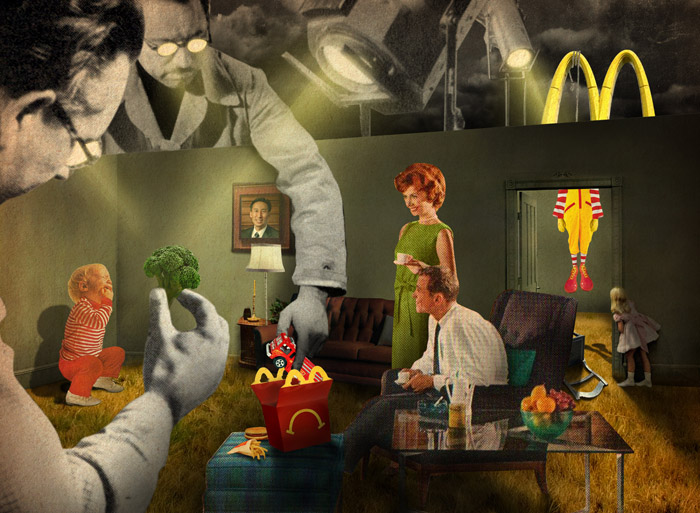
I chose this picture to illustrate the power it seems like we, common people, have with our food choice. We are basically being handed what to eat as a result of businesses. It seems like we are being fed from the company who wins the battle of who can advertise better. The food industry has become a corporation for profit, rather than an industry to feed people fuel and nutrients for their body. Our perception of the food system depends where we are in it. If we are the ones being fed, we may not even realize it is corrupt. We may not even think it is corrupt, as long as we have food on our plate. If we are feeding the people, we are either satisfied with it or not depending on how much profit we are getting. For example, small family farms are outraged, but Monsanto is loving it. Of course, this is also my perception of it, growing up in California and living in the Pacific Northwest, food awareness and politics is a very open topic and recognized.

I think power is a determinant of health if you have none. Having more power doesn’t necessarily mean you have good health, but you have more of the opportunity to be healthy. Without power, you are like a puppet being played by the corporate world of food and being stuffed with the root of their money.


 -Monica Huelga


Work Cited:

3. http://www.redicecreations.com/specialreports/monsanto.html
4. Monsanto.com
6. Janzen, John M. The Social Fabrics of Health: An Introduction to Medical Anthropology. The University of Kansas,


Walking For A Double Standard


The WHO’s World Health Statistics for 2012 highlighted how deaths due to noncommunicable diseases are on an exponential rise. “Of the estimated 57 million global deaths in 2008, 36 million (63%) were due to noncommunicable diseases (NCDs). Population growth and increased longevity are leading to a rapid increase in the total number of middle-aged and older adults, with a corresponding increase in the number of deaths caused by NCDs. It is projected that the… annual cancer deaths [will] increas[e] from 7.6 million to 13 million” (World Health Statistics). The World Health Statistics also reported that second largest proportion of NCD deaths (21%) are due to cancer. Cancer is a major health issue for the 21st century. “In the 1930s, a woman’s lifetime risk of breast cancer was 1 in 22. In 2011 it is 1 in 8” (“Pink Ribbons, Inc).

“Pink Ribbons, Inc”, a documentary that is based on based on the 2006 book Pink Ribbons, Inc: Breast Cancer and the Politics of Philanthropy by Samantha King, raises questions on the commercialism of breast cancer, how companies have begun to affiliate themselves with a pink-ribbon, also known as “pink-washing,” in order to increase profits and establish as positive public image while only contributing a minute amount of the proceeds to the cause. Yoplait’s Pink Lids Saves Lives campaign encourages consumers to take the pink lid off of the yogurt containers, clean them, and then mail them back to the company. For every top sent in, Yopliat will donate 10 cents to the cause. Simple, right? If you look closely, and do a little math, you’ll discover that if you ate three cups of yogurt everyday throughout the four months of the campaign, and sent in every lid, Yoplait’s total contribution is $34.00. In 2002, American Express had campaign that stated, “In the fight against breast cancer, every dollar counts,” yet they only donated a penny for every purchase made between September and December at participating stores. That means that if an American Express card owner bought a $1,000 coat, or a pack of gum, American Express only donated one penny. Jane Houlihan, the Environmental Working Group’s Senior Vice President of Research explains how there are no federal safety standards when it comes to cosmetics. Houlihan’s group has complied an online database of products called Skin Deep, and their research has show how some Avon products contain carcinogenic ingredients.

This documentary does a satisfactory job of showing the various perceptions of the culture surrounding breast cancer and the symbolism of the pink-ribbon that have risen due to the commercialism of breast cancer.


The film interviews an “Ivy League” support group in Austin, Texas for women diagnosed with Stage Four breast cancer (Stage Four is the last stage, so these women are forced to adjust to excepting the reality of death) who freely share their perceptions. The women in the group express an utter disgust of the symbolism of pink-ribbons. A member of the Ivy League stated that she was aware that people had good intentions with the pink-ribbon, but that in the end, all they saw was the pink-ribbon, and not the faces of the women who were “hurting and living” with breast cancer.

Barbara Ehrenreich, a writer and social critic who was treated for breast cancer in 2000 and 2001, expressed how as she was going through chemotherapy, she was “completely baffled at the language that said I was battling a disease. I wasn’t battling anything. I was forcing myself to comply with the treatments that were recommended. I was showing up for the chemotherapy sessions. Is that a battle?” The women who were diagnosed with Stage Four breast cancer considered the terms such as “battling” cancer to be condescending because it implies that those who lost the “battle” are the losers. They lost their fight against cancer, which makes the women feel as if they didn’t “try” hard enough, or failed in some aspect. Barbara Ehrenreich also refuses to label herself as a “survivor” because she believes it is a put down to those who did not survive, those who died from breast cancer. The women with Stage Four breast cancer see the message as painful, and that people are forgetting that they “can die in a perfectly healed state.”

The documentary also depicts the perception that women who “battled” breast cancer and “won” embrace the culture around the pink-ribbon. They make up the majority of the proud and enthusiastic women who were interviewed at fundraising events such as Race for the Cure. They actively label themselves as “survivors.” They believe in the ideas behind the events such as Susan G. Komen’s Race for the Cure, Row for the Cure, Jump for the Cause, Jump for Hope, Avon’s Walk for Breast Cancer. They believe that these events deserve their money, time, and dedication. The group of people who embrace the culture around the pink-ribbon also extends to the friends and family of “survivors” and “battlers” who are there to support them. The support group is attempting to do anything to overcome their feeling of helplessness in the situation. These Americans have good intentions, and their willingness, dedication, and passion to find a cure for breast cancer is accurately portrayed. The millions of miles they willingly walked for a cure, and the millions of dollars donated proves that Americans are attempting to actively participate in ending this endemic.

Corporate philanthropy can have a positive effect on diseases such as breast cancer, as long as corporations who want to affiliate themselves with the pink-ribbon incorporate those values into their everyday tasks. If they truly wanted to see the eradication of breast cancer, they should remove all possible carcinogens from any and all of their products, instead of creating a double standard. They should also support research that aims to find the root cause of cancer and any preventable measures. Currently corporations seek the pink-ribbon to increase their profits, and that is where capitalism fails the health of the American public. I do acknowledge that there are people within those corporations who truly care about finding a cure to breast cancer, but the bottom line of those corporations are to make a profit for their shareholders, not find a cure for cancer. Barbara Ehrenreich claims that, “The effect of the whole pink-ribbon culture was to drain and deflect the kind of militancy we had as women who were appalled to have a disease that is epidemic, and yet we don’t even know the cause of.”

Dr. Olufunmilayo Olopade (Director, Cancer Risk Center, University of Chicago) claims that the most important risk factor for developing breast cancer is being a woman.  Dr. Susan Love, MD, the president of Dr. Susan Love Research Foundation, worked as a surgeon for 20 years and noticed that there wasn’t a significant progress when it came to treating cancer, what she calls “slash, burn and poison,” which suggests that we do not understand the disease. Love claims that only about 20-30% of women diagnosed with breast cancer exhibits risk factors, and says how, “If we can only explain 20-30% of breast cancer, then we don’t know what causes it. We are missing something big.” Dr. Mhel Kavanaugh-Lynch, the director of the California Breast Cancer Research Program, further adds how her team is currently exploring possible environmental risk factors, but there are very few who conduct research in that area. Janet Collins passionately advocates for an increase of research in prevention. She claims that only 3-5% of all research funds goes to prevention. The lack of preventative research and research that explores risk factors are the current shortcomings of the commercialism of breast cancer.

The documentary exposes the shockingly polar differences between the women with Stage Four breast cancer and the “survivors,” including their support system. One group outright rejects the culture surrounding breast cancer and the symbolism of the pink-ribbon imposed by corporations and foundations. They believe that the wrong messages are sent through this culture, and how the ugliness, and ruthlessness of breast cancer is masked with a pretty pink-ribbon. On the other hand, there are women who have “battled” their breast cancers and came out on top. Those living in remission consider themselves “survivors” and proudly wear the pink-ribbons. They embrace the runs, walks, and jumps for breast cancer, and they feel welcomed in this community painted in pink. They are hopeful for finding a cure for future generations, and they proudly invest their time and effort into these grand events. These grand events amass millions of dollars, and yet only about 3-5% of those donations go directly to prevention research. These funds should be evenly distributed between researching future drugs/treatments, prevention research, and research that will shed light on all possible risk factors for breast cancer in order to impact this epidemic.


"World Health Statistics 2012." WHO. World Health Organization, 2012. Web.  
Pink Ribbons, Inc. Dir. Lea Pool. Prod. Ravinda Din. First Run Features, 2011. Film.

By: Cierra Leon Guerrero